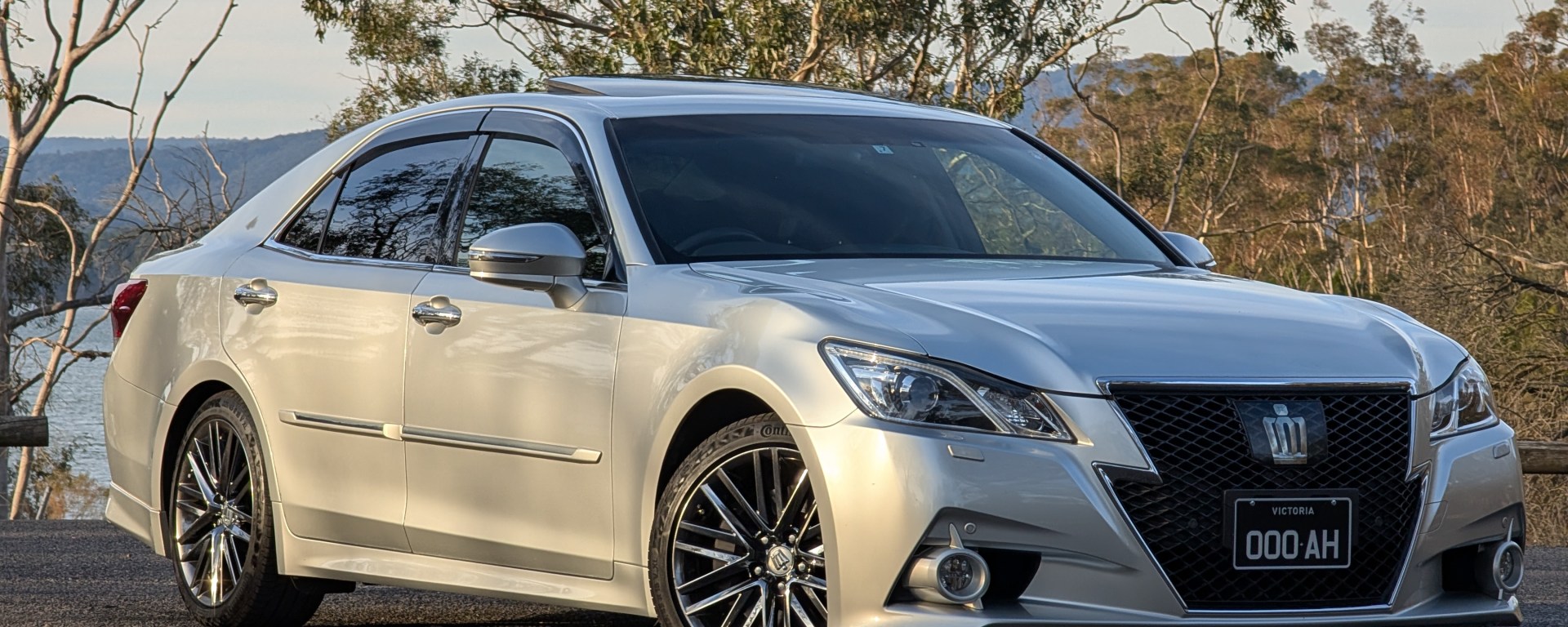
This article aims to offer a comprehensive guide to anyone looking to purchase a 14th-gen, AKA s210, Toyota Crown Athlete. It covers the different engines, drivetrains and trim levels that were offered when the car was new, as well as some advice and opinions about what options are the best.
At the bottom of this article is a fairly comprehensive list of features that were available with each engine/drivetrain/trim level, as well as the option packs that could be selected on top of these. Click here to jump there right away if you’d prefer not to read my opinion of these things.
First, a couple of disclaimers. All the information below was collected from a machine-translated scan of the options list for the Series 1 14th-gen Crown Athlete, published in 2013. Subsequent model years likely brought about changes to this options list, especially in 2015 when the model received a facelift. I currently don’t have access to later model year brochures, but if you do, please reach out as I’d be happy to incorporate any changes they brought about into this article.
There’s also a chance of mistranslation of some of the features, and I’d double check to confirm the car you’re looking at has them – especially safety-related stuff.
Now, onto the 14th-gen Crown Athlete and its many flavours. There were four engine/drivetrain combinations to choose from, and each of these came in two or three trim levels, with some individual options that could be ticked on top of that.
Engines and drivetrains – GRS214, AWS210, GRS210, GRS211
Starting with the engine/drivetrains, at the top end was the GRS214 naturally aspirated 3.5L V6 with an 8-speed torque-converter auto sending power to the rear wheels. This was essentially the go-fast variant of the Athlete with Toyota’s venerable 2GR-FSE 3.5L V6, pushing out 232kWm, and the new-for-the-model Aisin 8-speed.
It also featured upgraded brakes and steering to go along with its more powerful (and thirsty) engine, making it the pick of the bunch if you’re keen to carve the occasional corner as well as have something smooth and comfortable to daily-drive.
The 2GR engine itself is famously reliable and tolerant of abuse, and could be found in several Lexus and Toyota models internationally including the IS350 and GS350.
Looks-wise, the GRS214 featured some pretty unique 18-inch wheels with a dark chrome look, which I personally think look great for a factory wheel. These wheels were optional on cars with the lesser engines, which otherwise came with some more conventional-looking 17s.
One standout feature only available on the GRS214 in the top spec “G” trim was the soft-close doors – more on this later.
New for the 14th generation was the option of a Hybrid Athlete (AWS210). Unfortunately, this wasn’t the fire-breathing 3.5L V6 hybrid power package seen in the 13th-gen Crown – that combination was only available on the Majesta for this generation. Instead, the Athlete was saddled with the rather anodyne inline 4-based system commonly found in the Camry and RAV4. Oh well, at least it’d result in some fairly decent fuel economy – though keep in mind the hybrid battery won’t last forever and it will cost a fair chunk of change to replace when it eventually dies.
The hybrid also featured heated seats as standard across all trim levels – something that was only standard on the top trim Athlete G for other engine/drivetrain options. A heated steering wheel was also included – which wasn’t available on any other engine/drivetrain combo.
The last two engine/drivetrain options aren’t available to be imported into Australia as they don’t meet thresholds for performance or efficiency (i.e. they’re not powerful enough to be considered an “enthusiast car” and don’t feature the hybrid tech needed to be considered “green”). These are the GRS210 and GRS211, which both feature a 2.5L naturally aspirated V6 mated to a 6-speed torque converter auto. The GRS210 is RWD, while the GRS211 is AWD.
Even if you could import a GRS210/211 I’d probably still just go for the Hybrid given the 210/211’s 149kW/243Nm 4GR-FSE engine, as found in the Lexus IS250 and GS250, doesn’t exactly set the world alight performance-wise. The contemporary GS250 did receive plaudits for its smoothness though, if that’s your thing. And the lack of hybrid battery or eCVT would be another bonus. Not that any of this matters for us Aussies, as we can’t bring them in anyway.
Trim levels – Athlete G, Athlete S, or just plain old Athlete
Now with the powerplant options out of the way, it’s time to get stuck into trim levels. Typical of many JDM cars, there’s quite a bit of air between the top-spec Athlete G and the base model Athlete. Though the mid-spec Athlete S offered many of the same features of the G with – depending on your preference – one large caveat.
Starting from the top is the Athlete G, with the most obvious feature for most buyers likely being the full leather interior with heated and ventilated seats. Though these features were also available on the lower-level S as an option pack.
A really great feature unique to this trim (and not able to be optioned on the lower trims) are the adaptive high-beam headlights, which, similar to modern matrix headlights, will block out a portion of the beam around any cars in front of you, whilst still allowing for powerful illumination of the rest of the road and roadside. This is a really neat feature if you’re regularly driving country roads at night as it means you don’t have to constantly jump on-and-off the high beams when oncoming traffic appears – and you will have at least some of your high-beam sweeping the roadside for wildlife even if another car is coming towards you.
The real “wow” feature for the G is the soft-close doors, something you’d normally expect to find on a top-spec BMW 7-series or Mercedes S-class, cars that cost tens-to-hundreds of thousands of dollars more than the Crown. However, this feature was only available on the GRS214 3.5L V6. So if you’re getting the Hybrid or the GRS210/211, you’re out of luck.
With the above in mind, if you’re mostly a city driver and you don’t care about the theatrics of soft-close doors you can find most of the G’s features in the lower S trim. Just keep in mind it might be hard to find an S with leather seats if you really want them. And be warned, it’s very common for Athlete Ss to be fitted with leather seat covers, which can look pretty close to the real thing, but they’ll miss out on ventilated (and heated, if it’s a non-hybrid) seats. For this reason some people still go for the G – but will jump on an S if one comes up with the leather option ticked.
Another thing to note is that several other desirable features – radar cruise control, front and rear parking sensors, a 360-degree camera, the 16-speaker premium sound system and sunroof – were all optional even on the Athlete G. Radar cruise and parking sensors are fairly common, but the 360 camera and premium sound are rarer. Finding a car with all these options ticked? Quite a challenge.
Just a note on radar cruise – it can only be set to speeds above 47km/h, and will cut if the speed of the car it’s following drops below 40km/h. This annoyed me a bit as low-speed bumper-to-bumper traffic is one of the best use cases for radar cruise. Both regular and radar cruise also max out at 115km/h and, as the speedo overshoots by about 5-6km/h, in the real world it maxes out at 109-110km/h.
So, the Athlete S, while a step down from the G, was still fairly well equipped, including power-adjustable front seats, a decent 10-speaker sound system (also standard on the G) and rear privacy glass. Probably the key thing missing for many buyers is the leather seats, replaced by power-adjustable fabric seats that, to some, will cheapen the feel of the cabin somewhat. The lack of heated seats on non-hybrid cars is also a bit of a miss for a premium/luxury sedan, even when this generation arrived in 2013.
The S still comes with the Crown’s iconic swing vents too, another idiosyncratic feature that will really impress your passengers even if their utility will be questioned by some. My wife actually finds them annoying as she normally points all the vents away from her when sitting in the car. I still love them though.
Toyota’s excellent smart-key system is also fully functional on the S. This allows you to unlock the car with the key fob in your pocket just by grabbing any exterior door handle. You can also lock the car with a quick touch of the top-right portion of the handle (a small ridged section indicates where you should place your finger). This is excellent functionality that really streamlines the way you get in and out of the car.
The S does miss out on the credit card-shaped keyfob offered with the G (in addition to a standard keyfob) – which can (usually) fit into your wallet so you have one less thing to carry around with you – but it’s not a huge deal. Some people won’t like the credit card key anyway as it forgoes all buttons and therefore the ability to lock the car remotely in the more traditional way, as is still possible with the standard smart key fob.
Finally there’s the base model, simply called “Athlete”. It comes with some “features” not present on the higher trims – mostly because they make the car cheaper. This is real rental car-spec stuff – and the complete lack of a Toyota infotainment system will be a dealbreaker to many (though a DIY car stereo person might find this to be a plus).
Yes, that’s right, the base Athlete lacked the large touchscreen infotainment system as standard, with, erm, apparently nothing in its place. The idea is that you BYO head unit, something that I’ve seen quite a bit in JDM kei cars but had no idea it would also stretch to larger models like the Crown. Note the base Athlete still comes with the smaller touchscreen that houses the HVAC/drive mode controls and sits below where the head unit would go, which is standard across all trims. I still can’t quite believe it’s true that the base model Athlete doesn’t come with an infotainment system. If this is some sort of translation error, please let me know.
A Crown for everyone.
So that’s about it for the various engine, drivetrain and trim options. What’s the best option? It really depends on what you’re looking for in a car.
If you don’t care about straight-line performance the Athlete Hybrid makes for an excellent choice. If you also don’t care about sharp handling and a sportier ride I do suggest cross-shopping with the Royal Saloon though, as many of these offered some more toys for the back seat and a softer suspension (up to you if you like the design, though).
If you do enjoy an occasional traffic light grand prix, and a weekend trip driving the twisty backroads – the GRS214 is an excellent do-it-all machine – as long as you can stomach its enormous appetite for premium (98+) fuel. If you don’t mind driving something more compact and with a more spartan interior though, a Toyota Mark X 350 or GRMN, which has the same engine as the GRS214 in a smaller (Lexus IS-sized) package, is an interesting alternative.
In terms of trim levels, I’d avoid the base Athlete as too much stuff is cut – but it can be trickier choosing between an Athlete S and an Athlete G. For a lot of people it will come down to whether they think the adaptive high beams will be useful, and/or whether they can be bothered trying to find an Athlete S with leather. If you don’t care about leather seats, adaptive high beams or soft close doors, then you’re not missing out on much by going for the S. Personally, I went for the G as I wanted leather and the soft close doors, while the adaptive high beams are a nice – if rarely used – bonus.
Options-wise, the Advanced Package (radar cruise, parking sensors, AEB) was also a must-have for me. This is mostly for the front sensors, which I find really handy in tight places like car parks. The autonomous emergency braking (AEB) is also one of the few active safety systems that I’m a fan of – as long as it’s implemented well. Thankfully the Crown’s system is not overly sensitive as I’ve experienced in some cars.
One thing to note is that if you’re looking to get a car with the Advanced Package, you can usually spot it from the presence of parking sensors on the car’s exterior. However, theoretically, these could be optioned separately, so to really make sure, check for the radar cruise following distance botton on the steering wheel. If that button is present, the car is fitted with the Advanced pack.
Features and Specifications
Below is a full list of features laid out by engine/drivetrain, then by trim level, with the list of standard kit right at the bottom. I hope this helps and please reach out with any questions, comments or corrections.
Drivetrains/Engines:
GRS214 – 3.5L V6, naturally aspirated, 8-speed automatic, RWD
Unique features:
- High performance powerplant (232kW/377Nm)
- Standard 18 inch chromed aluminium wheels (optional on all other drivetrains)
- Bi-modal exhaust
- Ventilated disc brakes front and rear (all other drivetrains only have front-ventilated disc brakes)
- Front disc brakes feature a 4-piston caliper
- Variable Gear Ratio Steering (VGRS) – required steering input changes depending on how fast you’re going
- 8-speed torque-converter automatic (other non-hybrid drivetrains feature a 6-speed)
- Steering wheel paddle shifters
- Soft close doors – this is ONLY on the top-spec GRS214 Athlete G, but it isn’t available on any other drivetrain at all
Why you’d choose this drivetrain:
- Best performance of the Athlete models – 0-100km/h in about 5.3sec, plus better brakes and handling
- Soft close doors (if you get the G spec) – this is an iconic Crown feature usually only seen on much more expensive cars outside Japan (e.g. Rolls Royce)
Why you might avoid this drivetrain:
- Very thirsty (10.4L/100km claimed, it’s usually worse than this unless you live on the highway)
- Minimum required octane is 96 RON – which basically means you need to fill it with 98 or 100 in Australia
AWS210 – 2.5L inline 4, hybrid, eCVT, RWD
Unique features:
- Hybrid drivetrain
- Hybrid badging (including a blue shadow effect for the front badge)
- Regenerative braking
- Heated steering wheel
- HVAC front-seat concentration mode (stops air blowing to the back seats – this is likely because the engine runs cooler and therefore the heater is less effective than in a non-hybrid car)
- Foldable luggage board for the boot – presumably as the boot mat and luggage tray featured in the non-hybrid cars won’t fit
- Vehicle approach notification device – makes a noise to alert pedestrians that the car is approaching (necessary as the car is silent in EV mode)
- Heated front seats across all trim levels (on other drivetrains, this is an option for the Athlete S and not available on the base Athlete)
Why you’d choose this drivetrain:
- Best fuel consumption (4.3L/100km claimed)
- You really like heated steering wheels and front seats
- Substantially cheaper than the GRS214
Why you might avoid this drivetrain:
- Hybrid battery will eventually need replacing and will be expensive
- Average performance (this is not the 3.5L V6 hybrid drivetrain seen in the 13th gen Crown)
- eCVT not to everyone’s tastes
- Some boot space lost to the hybrid battery
GRS210 – 2.5L V6, naturally aspirated, 6-speed automatic, RWD
Unique features:
- None
Why you’d choose this drivetrain:
- It’s presumably the cheapest option
- Slightly better performance compared to the hybrid
- Traditional 6-speed auto over the hybrid’s eCVT is preferable to some drivers
Why you might avoid this drivetrain:
- Importing this drivetrain into Australia is not allowed as it doesn’t meet performance or efficiency thresholds
GRS211 – 2.5L V6, naturally aspirated, 6-speed automatic, AWD
Unique features:
- AWD drivetrain
Why you’d choose this drivetrain:
- You live somewhere slippery where the AWD drivetrain will come in handy
Why you might avoid this drivetrain:
- Importing this drivetrain into Australia is not allowed as it doesn’t meet performance or efficiency thresholds
- Pretty thirsty given the middling performance numbers (9.8L/100km claimed)
Trim Levels
Athlete G (available on all drivetrains)
Standard features not available on other trim levels:
- Adaptive high-beams
- Seat, steering wheel, door mirror position memory function (can be set for two different drivers)
- Driver seat automatically slides back for easier driver entry/egress
- Second key is a credit card-style smart key (as opposed to a normal fob-style smart key)
- Soft close doors and boot (GRS214 only)
- Manual rear-door sunshades
Standard features that are optional on other trim levels:
- Electric rear windscreen sunshade (optional on the Athlete S)
- Rain-sensing wipers (optional on the Athlete S with the B Pack)
- Side mirrors tilt-down on reverse and puddle lights (optional on the Athlete S)
- Auto-dimming rear view mirror (optional on the Athlete S with the B Pack)
- Leather seats (optional on the Athlete S with the C Pack)
- Heated and ventilated front seats (optional on the Athlete S with the C Pack)
- G-BOOK MX Pro (emergency call system – only works in Japan) (optional on the Athlete S)
Athlete S (available on all drivetrains)
Standard features (also standard on the Athlete G) not available on the base Athlete:
- Exterior door handles – body colour w/ chrome inset – the regular Athlete lacks the chrome inset
- NAVI-AI-AVS – Adaptive variable suspension will adjust itself based on your GPS location – this feature won’t work outside of Japan
- NAVI-AI-SHIFT – Adaptive shift patterns based on your GPS location – this feature won’t work outside of Japan
- Winshield with top shade (the blue bit at the top that reduces sun glare – I can’t believe this isn’t standard across the range)
- Rear privacy glass
- Side mirrors position memory (presumably this is standalone to the memory seat function)
- 6-light LED centre brakelight (the base Athlete is a 4-light unit)
- GPS-synchronised digital clock (the base Athlete’s clock must be manually set)
- Electric tilt and telescopic adjust steering wheel with auto tilt away & return
- Nanoe ioniser (for the HVAC system)
- Swing vents – an iconic Crown feature, the centre-front HVAC vents can be set to swing side-to-side
- 8-way power adjustable driver seat (6-way manual adjustable on the base spec)
- 4-way power adjustable front passenger seat (manually adjustable on the base spec)
- Driver seat electric lumbar support
- Smart key entry on all doors (on the base Athlete smart key entry is only on the driver door and boot)
- 10-speaker “Crown Super Live Sound System” (the base Athlete does not have a sound system)
- Security alarm
Standard features (also standard on the Athlete G) that are optional on the base Athlete:
- Water-repellent front door glass (this coating has probably broken down by now)
Athlete (not available on the GRS214)
Key “features” are:
- “Audioless” (this was optional on the Athlete S)
- Body-colour door handles (chrome on the higher trims)
- Front door glass is only UV-filtered and not water repellent as seen in the other trims
- Clear rear window glass (as opposed to tinted on the higher trims)
- Digital clock is manually set (not GPS set as in the higher trims)
- Four-spoke urethane steering wheel (leather-wrapped in the higher trims)
- Manual 6-way adjustable driver seat (8-way power adjustable on higher trims)
- Manual 4-way adjustable front passenger seat (powered on higher trims)
- Smart key entry for drivers door and boot only (i.e. you can’t lock/unlock the car with the smart key in your pocket from the passenger doors like you can with the higher trims)
Standard Kit
The following features are standard across all drivetrains and trim specs
- Puncture repair kit (Space-saver spare wheel was optional across all trims)
- Rear spoiler
- Adaptive variable suspension
- Cruise control (Radar cruise optional on Athlete S and G)
- Drive start control (I think this is push-button start)
- Adaptive Variable Suspension (AVS) – adjusts the suspension firmness at each wheel depending on vehicle speed, brake force, acceleration, steering input and whether “Sport” mode is selected
- Hill start assist
- UV filtered windshield with sound insulation
- Heated power-folding door mirrors
- Auto-leveling bi-xenon headlights
- LED front fog lamps
- Emergency brake signal
- Rear-view mirror with anti-glare coating
- 5-inch touch screen for HVAC controls, drive mode select and some other functions. Note this is not the infotainment display, which (on most trims) is larger and sits above this display
- Optitron instrument cluster – analogue cluster with illuminated needles
- TFT colour multi-information display – this sits in the middle of the cluster for trip computer functions. Note this display is in Japanese only, the language cannot be changed to English – though on hybrid models a company in New Zealand offers clusters that have been converted to English which need to be swapped out with the existing cluster
- Eco-drive indicator – a small light in the instrument cluster that tells you when you’re drive economically
- Steering wheel controls for audio and the trip computer
- Black woodgrain shift knob
- 12V socket – 120W
- Dual-zone climate control with a pollen removal mode
- Rear seat centre armrest with cupholders
- ISOFIX anchor points and top tether for the left and right passenger seats. Note for Australian compliance your compliance workshop will install a third top tether for the middle seat
- Centre console with lid that opens from both sides (a real Lexus – and fancy Toyota – thing)
- Door pockets with bottle holders
- Moveable rear reading lamp
- Overhead sunglasses holder (this is not available on cars with a sunroof)
- Rear HVAC vents
- Vehicle speed-dependent automatic door lock function
- Engine immobiliser
- Toolkit (jack, hub nut wrench)
Standard safety kit includes:
- Vehicle Dynamics Integrated Management (VDIM) – essentially Toyota’s suite of safety systems including electronic brakeforce distribution (EBD), anti-lock brakes (ABS), vehicle stability control (VSC), traction control (TRC), electric power steering (EPS)
- Driver, passenger, driver knee, front side, curtain front and rear airbags
- Whiplash injury-reducing front seats
- ELR 3-point seatbelts on all seats
- Adjustable seatbelt anchors (front seats)
- Seat belt warning light and buzzer
- Rear door child locks
Option Packs
The following option packs were available on certain trims:
Advanced Package (A Pack) (available on the Athlete G or Athlete S):
- Radar cruise control
- Front and rear parking sensors with “Intelligent Clearance Sonar”, whereby the car will automatically brake if it determines it’s about to hit something at low speeds. Note parking sensors could also be optioned separately without the automatic braking function
- Pre-crash safety system (i.e. auto-emergency braking)
Driver Support Package (B Pack) (Available on the Athlete S, all these features are standard on the Athlete G):
- Rain-sensing wipers
- Auto-dimming rear view mirror
- Electric tilt and telescopically adjustable steering wheel with auto tilt-away and return upon vehicle entry/egress – Note this feature was standard on the GRS214 3.5L V6 regardless of trim level
Leather Seat Package (C Pack) (Available on the Athlete S, all these features are standard on the Athlete G):
- Leather seats
- Heated front seats – Note this feature was standard on the AWS210 Hybrid regardless of trim level
- Ventilated front seats
Individual Options
The following features could be optioned individually:
- Panoramic 360 degree camera (this option was only available on the Athlete S or Athlete G)
- Toyota 16-speaker Premium Sound System – includes speakers in the ceiling and noise-cancelling speakers either side of the front-seat headrests (this option was only available on the Athlete S or Athlete G)
- Tilt and slide sunroof (this option was only available on the Athlete S or Athlete G)
- 18-inch chrome wheels (standard on the GRS214 3.5L V6), these replaced the standard 17-inch wheels
- Space-saver spare wheel
- Water-repellent front windshield (standard on all trims except the base Athlete)
- Rear fog lamps
- 4-light centre rear brake light (this is standard on the base Athlete, but optional on the higher trims which otherwise have a 6-light brake light)
- Front and rear parking sensors (note if this option lacks the “Intelligent Clearance Sonar” function available in the Advanced Package) (this option was only available on the Athlete S or Athlete G)
- G-BOOK MX Pro – emergency call system – only works in Japan (standard on the Athlete G, optional on the Athlete S, not available on the base Athlete)
- ITS Spots DSRC unit – appears to be some sort of points-of-interest system – only works in Japan (this option was only available on the Athlete S or Athlete G)
- “Audioless” – i.e. no head unit – see the commentary about this “feature-delete” option under the base Athlete section (standard on base Athlete, optional on Athlete S, not available on Athlete G)
- Audioless cover – presumably a coverplate for the centre dashboard if you choose not to install a head unit for whatever reason – this was a dealer option that ran alongside the “Audioless” option above
- Cold weather spec – this includes a de-icer and other tools
 Ant's Cars